Showing posts with label Church. Show all posts

Thursday, August 12, 2010

Pastor Lester MacKinnon, 1937-2010

The pastor emeritus of our church, who served for over 50 years, went home this past Lord's Day.
God greatly used his servant - a young boy from Canada who came to the USA for training and planted his life in a church and a community (Fellowship Chapel, Bristol, Virginia).
I have set up a memorial site at the link below, with the obituary, sermon audio, video, etc.

Saturday, February 06, 2010

Resource for Guest Preachers and Churches: Church Information Form

CHURCH INFORMATION FORM (feel free to distribute this form freely)

If you are a guest preacher or a church planning to host a guest speaker, the items on the form below can help make sure the preacher and the church are on the same page. Click here to download the church information form in Word document format.

Monday, October 27, 2008

Chattanooga 9Marks Workshop audio

from the Concord Baptist Church website:

Building Healthy Churches

Below is the audio from the 9Marks workshop held at Concord on October 17-18, 2008. At this workshop, many church issues were examined through the light of Scripture to help us answer this question: "What does a healthy church look like?"
Right click and select "save as" to download.

Thursday, December 13, 2007

Book Review at SharperIron: What Is a Healthy Church?

SharperIron has published my book review of What Is a Healthy Church? here.
New Attitude has made part of the book available online and plans to offer more: see here. UPDATE: Click here for the helpful list of things to think about if you're thinking of leaving a church (another excerpt from the book). (HT: Justin Taylor)

Tuesday, November 13, 2007

Book Review-Give Praise to God

Philip Graham Ryken, Derek W. H. Thomas, and J. Ligon Duncan III, eds., Give Praise to God: a Vision for Reforming Worship (Phillipsburg, New Jersey: P&R, 2003), 516pp. Indices: Scripture, and Subject and Names.
reviewed by Doug Smith
Give Praise to God celebrates the legacy of James Montgomery Boice, late pastor of Tenth Presbyterian Church in Philadelphia. While not a book about Boice, this book honors his commitment to the glory of God by considering various dimensions of worship. The editors present a foreword, introduction, eighteen chapters, and an afterword from eighteen respected church leaders primarily from Presbyterian and Baptist backgrounds. In addition to the editors themselves, R. C. Sproul, Edmund P. Clowney, R. Albert Mohler Jr., Mark Dever, Terry L. Johnson, D. Marion Clark, Richard D. Phillips, Paul S. Jones, Donald S. Whitney, William Edgar, W. Robert Godfrey, Nick R. Needham, Hughes Oliphant Old, and Michael S. Horton contribute to this tome. Most chapters are so helpful as to deserve their own review, but space will only permit a brief survey in comparison to what this work deserves.
This book is the fruit of much research, experience, and zeal to help Christians think more biblically about how we are to worship God. It is divided into four sections.
Part one, "The Bible and Worship," begins with a helpful consideration by Ligon Duncan of what God says about how we ought to worship. Derek Thomas defends the regulative principle of worship, concluding that it frees us from the whims of men to worship God according to the Bible. Edmund Clowney writes on "Corporate Worship As a Means of Grace," but seems to skate over the surface and not really explore exactly what he means by "means of grace."
Part two covers the "Elements of Biblical Worship" in detail. Al Mohler makes a compelling case for expository preaching and Mark Dever shows how it ought to proclaim the Gospel, no matter what text the preacher is covering. Duncan and Terry Johnson urge the public reading and praying of the Bible, something that many "Bible-believing" Christians have sadly neglected. Marion Clark's chapter on the meaning and practice of baptism is helpful and thought-provoking even to those of us who reject infant baptism. Richard Phillips thinks deeply about the Lord's Supper and the practical considerations that attend it. Paul Jones persuasively defends the use of "hymnody in a post-hymnody world," while Terry Johnson invites us to the riches of Psalm-singing, arguing for inclusive psalmody (as opposed to exclusive psalmody, which permits no hymns of human composition).
Part three focuses on "Preparing for Biblical Worship." Don Whitney calls us to worship God daily in private, while Duncan and Johnson cry for a return to family worship, both chapters providing practical suggestions for including Scripture, prayer, and song in those times. William Edgar reminds us that we are to renew our minds in order to worship God in all of life. Robert Godfrey looks at the role of the emotions in worship, briefly critiquing Jonathan Edwards while upholding the legitimacy and necessity of emotions that issue from faith in Christ.
"Worship, History, and Culture" is the fourth and final part of the book. Nick Needham gives a very helpful and fascinating overview of "Worship Through the Ages" that covers a wide spectrum of time periods and church traditions. Hughes Oliphant Old explores "Calvin's Theology of Worship." Michael Horton proposes that the answer to the "Challenges and Opportunities for Ministry Today" is a countercultural faithfulness to the Gospel of Jesus Christ, which is so contrary and offensive to this present evil age.
This book is a refreshing and relevant contribution to the literature of the church and worship. It is refreshing and relevant for the same reason: it prescribes faithfulness to the Bible, not a desire to cater to the whims of culture and marketing gurus, as the driving force in defining our philosophy and practices. It reminds us that worship is centered on God, not man, and that this God has spoken and made matters very clear about how He is and is not to be worshiped. Expositional preaching, substantive Scripture readings and prayers, biblically based songs, and obedient observance of baptism and the Lord's Supper should characterize our local churches. We should be regularly engaged in worshiping God as individuals and families. We need to apply His Word to all of life, loving Him with all our heart, soul, mind, and strength. Attention to the issues discussed in this book should deepen our sense of awe and wonder at the majesty of God. It serves to instruct our minds with truth so glorious that reverence, joy, and praise should be the inevitable results.
This book certainly belongs in the hands of church leaders, particularly pastors and music ministers. Church members would also profit from considering the material in many of these chapters, because this book calls us all to think rightly about how we approach and interact with God. It reminds to look to God's Word for instruction on worshiping Him, helping us to avoid the idolatry we are so prone to. A welcome antidote to the man-centered, market-driven ideas that masquerade as wisdom on worship, this book shows us why and how we should Give Praise to God.
This review has been submitted to www.discerningreader.com. RELATED RESOURCES: Robert G. Spinney wrote a booklet (free .pdf) to "highlight the key points" of Give Praise to God: “Looking for God in All the Wrong Places: an Appeal for Word-Based Corporate Worship.” Hartsville, TN: Tulip Books, 2006. An adaptation of the chapter by Ligon Duncan and Terry Johnson, "A Call to Family Worship" (free .pdf download accessible from the link) A lesson from Don Whitney: "How to Pray Through Scripture"

Friday, November 09, 2007

Book Review-What Is a Healthy Church?

Mark Dever, What Is a Healthy Church? (Wheaton, Illinois: Crossway, 2007), 126pp.

Reviewed by Doug Smith

This book is new, but it's not really new. What Is a Healthy Church? first appeared in public as a series of articles in a church newsletter. It then became a booklet ("9 Marks of a Healthy Church" – free .pdf), and later a full-size book ( Nine Marks of a Healthy Church). Now it is a small book. And it seems to get better each time. So, what is a healthy church?

Summary

Mark Dever is the senior pastor of Capitol Hill Baptist Church in Washington, D. C., and founder of 9Marks Ministries. His prescription for a healthy church is provided here in a very useful format. The book is divided into three sections: 1) What Is a Healthy Church?; 2) Essential Marks of a Healthy Church; and 3) Important Marks of a Healthy Church. In part 1, he explains how Christians are to relate to a church and how the church's purpose is to display the glory of God. Parts 2 and 3 give the nine marks, with the first three considered essential (expositional preaching, biblical theology, and a biblical understanding of the good news) and the last six designated as important (a biblical understanding of conversion, evangelism, and church membership; biblical church discipline, discipleship and growth, and church leadership). One should probably not be a part of a church that is defective in the essential marks, whereas more patience, love, and instruction may be what are needed to develop the other six marks.

The book challenges us to think seriously about the church, and not consider it an "option" for Christians, but part of who we are. It reminds us that the diet of a healthy church is faithful expositional preaching, where God's Word is exposed constantly, so that hearers are not limited by a proclamation of what the preacher already knows. Biblical theology helps us in knowing the full counsel of God and not avoiding controversial yet important teachings such as election, man's depravity, and the nature of the atonement. The Gospel message is clear, as is the nature of true conversion and faithful evangelism, which proclaims the good news and calls for repentance and faith in the Savior. Church membership is a serious matter, as it entails commitment and responsibility on the part of members and an affirmation of their salvation by the church to which they belong. Church discipline is important to protect the purity of the church and its testimony. While discipline "is fraught with problems of wisdom and pastoral application," that is no excuse for its neglect, as the message sent by a lack of discipline is that the unrepentant church member is okay, when, in reality, the church should not be able to honestly affirm their salvation. Discipleship and growth lead to increasing self-denial and personal holiness in believers. Church leadership should be modeled after the plurality of elders seen in the New Testament, while the final authority lies in the congregation. Church leaders are to be mature men who have the ability to teach God's Word.

Dever gives caveats to church members and pastors encouraged by this material: don't try to see change happen too fast; pray, wait, set a good example, and love the people of your church. Extras include tips for those thinking of leaving a church, how to find a good church, and what a typical church covenant of a healthy church could look like.

Evaluation

What Is a Healthy Church? is an easy, fast read that challenges much modern thinking about the church (even among conservative Christians). It is simple, helpfully provocative, and to the point. Church members as well as pastors and seminarians would profit from this resource, which has fertile soil for further reflection. Whether you have Dever's materials already or have never read him, this little book is well worth picking up (only $5 from 9Marks). It is recast in such a way that I find it helpful to have along with the more detailed Nine Marks of a Healthy Church book.

While substantive, the book is an introduction to these ideas, and not a handbook for fleshing them out in great detail (Paul Alexander and Dever wrote The Deliberate Church for that purpose). By no means a full ecclesiology, this book deals briefly with matters such as baptism and the Lord's Supper as they relate to the nine marks set forth. It is written with the understanding that a healthy church will celebrate the ordinances, and live out other normal practices of the church, such as praying together.

The book reminds us of the importance of the church as God's vehicle for displaying His glory to the nations. His Word is central from creation to consummation, and ought to be preached faithfully, not neglecting any part of the Bible. Therefore, preachers ought to, in some way, preach systematically and regularly through the Bible. It is a necessity for a healthy church.

It is important for the health of the church to understand what a true Christian is. Therefore, we should not idolize numbers. Regularly having attendance far below a church's membership should be a scandal and shame to us. We should not simply see the praying of a prayer as the evidence of "successful evangelism." Rather, we should proclaim the Gospel and its demands clearly and pray that the lost will come to Christ in faith and follow Him. We certainly need to be obedient in evangelism, but we also need to trust God for the results as we share the good news as He has revealed it in His Word. We should make the true nature and value of membership known, both in taking in new members and disciplining those who refuse to repent of known sin. We ought not to give testimony, even implicit affirmation, that people are Christians when their lives loudly and consistently proclaim otherwise.

The view of biblical eldership set forth in the book may be hard to swallow for some. But Dever makes a convincing case by the usage of the word in the Scriptures. He also shares personal benefits he has derived from being one of a group of elders. A plurality of qualified, godly leaders would do much toward improving and maintaining a healthy church, particularly in circles where churches often center around a strong personality. It can be a protection for the preaching pastor as well as for his people. Dever writes of biblical eldership, "If implemented in our churches, it could help pastors immensely by removing weight from their shoulders and even removing their own petty tyrannies from their churches."

This book presents old truths in a fresh way. These are foundations that are easily assumed or neglected. What Is a Healthy Church? confronts us lovingly and clearly with the meat and potatoes of what it takes to begin displaying God's glory to the world as His church.

Read the Table of Contents, the Introduction, and Chapter 1 (.pdf files) online for free.

For more on discipline and church government, see Polity, edited by Mark Dever, and available as a free download here.

Here is another review (Trevin Wax).

Monday, October 29, 2007

9Marks Workshop Online

Check out these 6 free .mp3 downloads from 9Marks' Northbrook workshop. This is an excellent resource on theology, preaching, the church, evangelism, and leadership.

Thursday, September 27, 2007

A Tale of Two Churches

To take a little liberty with Dickens, "It was the worst of times, it was the best of times." At least that's how it seems in some ways when I consider this situation I am writing about in this article. Recently, I have become acquainted with two churches in two different cities that present a sobering lesson simply by their contrast. Also, this coming Lord's Day, September 30, is an important milestone for them both, as one ends and another celebrates a new beginning. I will not refer to their names or locations, but simply call them "church x" and "church y" here. Church x is disbanding. Their final service is this weekend. The work began a few decades ago. It is a doctrinally sound ministry with a faithful pastor who has labored 20 years among a congregation that has dwindled to a handful. They did not reach their decision overnight. They sought the Lord about this and their concerns were shared with others for prayer. It is a day in which they still wish to rejoice in the Lord, although in the midst of sorrow. Church y is dedicating its new building. This congregation has a history of about a century. Their historic meeting house was burned by arsonists some time back. They met in a community center in the interim time. They have been without a pastor for some time, although they are looking and praying. They are grateful to be in their new facilities and for God's provision in this matter. This church desires to exalt the Lord and be faithful to the Bible. They want to be a light to their community and reach people with the Gospel. Why does church x disband and church y dedicate a new building? Why cannot they both continue and go forward for the Gospel? We do not know all the answers. We sorrow with the one (church x) and rejoice with the other (church y). Yet for another reason we rejoice with both - and it is a reason that transcends us and the people we know in our time. Our reason for joy is a promise. The Son of God, the Messiah, the promised one of God who is the Word and our Sovereign King, the One who destroyed the work of the devil by dying on the cross for our sins and rising from the dead, guaranteed that He would build His church and the gates of hades would not prevail against it (Matt. 16:18). This is true even when a local church disbands. God's purpose still stands. We hate to see a lighthouse removed from a community. But we should rejoice in regard to church x that it has not brought reproach on the name of Christ through false doctrine or moral scandal. We should rejoice at the years of faithful labor. We should rejoice at what has been evidence of God's work and we should rejoice that there is work that has been done there that we will only know about in eternity. We should pray for the members that they will be quickly joined to another local assembly where they can faithfully serve and hear the Word faithfully preached. We should pray for the pastor that the Lord will encourage his heart and continue to use him. His labor has not been in vain. For church y, let us pray that God will bless them and that they will remain faithful to Him. May He bless them with a faithful undershepherd. May they grow much in His grace. In all these things, praise God that whatever happens with any local church, Christ will continue to build His church, the one He purchased with His own blood, and nothing will stop our omnipotent Lord. Things seem to be uncertain to us in times like these - times that seem the worst for some and the best for others - but the promise of Christ is guaranteed.

Tuesday, September 18, 2007

More on the Weekender at CHBC

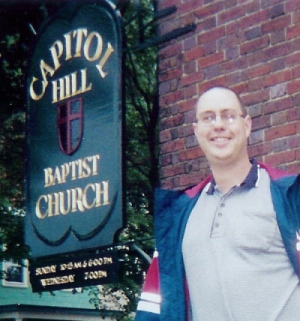
I thought I had done a pretty comprehensive article on the Weekender at Capitol Hill Baptist Church that I attended a year ago. At least, it was a profitable way for me to revisit and encapsulate what I had learned. Well, Noah Braymen, who is presently an intern and was at the Weekender with me last year, has far exceeded my article for comprehensive coverage, detailing the events of this past weekend. I have not had time to read them all yet, but am looking forward to doing so: Noah, thank you for this helpful service! This is a great event for present/future church leaders to attend.

Sunday, September 16, 2007

Second Life, Disembodied Evangelism, and Other Considerations in Sharing the Gospel of Christ

Our church just held its third monthly men's theology discussion meeting. We gather on a Saturday morning to consider a topic and its application to us. In July, we discussed the Christian Sabbath. In August, we began a discussion of evangelism and concluded it this past weekend. Involved in this profitable discussion were visitors, other pastors, and a staff member of Presbyterian Evangelistic Fellowship. They contributed a good deal to the conversation in addition to what men from our church brought to the table. What follows is an unofficial distillation and summary of that conversation mixed with some expanded thoughts of my own mixed in.
What Is the Gospel?
We discussed the need to know what the Gospel actually is. It is good news. It is about someone who actually did something. The first promise of the Gospel, Genesis 3:15, reveals that it is fundamentally about One who would actually accomplish the crushing of the serpent's head. Jesus Christ, the God-man, died and rose again so that our sins could be forgiven and we could receive eternal life. But there are other things we need to share for this to be understood as good news. People need to know who they are as sinners, and who God is. God created all things for His pleasure, and made man in His image, to reflect His glory. We must set before people the holiness, perfection, and majesty of God and show them the stark contrast of it with their sin.
By sin, man misrepresents God. Instead of communicating that God is good, wise, trustworthy, and has authority over us, sin sends the message that God is not good since He denies us something that we want, that God is not wise, that we can't trust God, and that we don't have to obey God but can do our own thing. It is slander and treason against the King of the universe and worthy of eternal death. Sin cannot be seen as "no big deal" or something to simply be overlooked when we consider it in this light. And this pertains to those who outwardly appear as moral persons as well. They are not "being good" for God's glory, but are living for themselves. They desire to avoid negative consequences, to live longer, to be more successful, to gain a good reputation for themselves, instead of living to make God known and show Him as supremely valuable and worthy of worship.
The law shows us how these things personally apply to us. When we look at the commandments and at Jesus' explanation of them in the Sermon on the Mount, for example, we should realize that we do not measure up to God's perfect standard and that we are guilty in His sight. There is no way that we can make amends and fulfill His demands upon our lives. That's bad news. But that's why the Gospel is good news.
The Gospel is also a call to commitment. It is not a mere intellectual decision that amounts to what the demons have (James 2:19). It is a call to repent of our sin and trust in Jesus. This call is both an invitation and a command. In regard to the invitation aspect, we should not see it as an invitation to a pancake breakfast by a social club, but as an invitation to appear before the President, only much more commanding of our attention!
In sharing this message, it is appropriate and even necessary to clarify that this is not an additive or something to make our lives more comfortable. It is not "ask Jesus into your heart" and then go your merry way. It is about having God's wrath against our sin dealt with. It is a call to die. It is a call to forsake our sin and embrace Christ. It is a summons to cease our rebellion and become followers of Jesus. We must not spread the false idea that discipleship is a later option for a believer. If we come to Christ, believing, we are to follow Christ. This is the inevitable fruit of a changed heart. It doesn't mean that we do a meritorious work to get God's favor or that we are perfect in thought and deed in all ways immediately after trusting Christ, but it does mean that we actually are relying on Jesus Christ as our righteousness and the One who came to deliver us from sin.
The Centrality of the Local Church in Equipping the Saints
Christ died for the church. We should see it as important, and such a view takes concrete expression when we are committed to our local church. In this context we should get equipped to share the Gospel. Parachurch ministries can be helpful, but they should not be allowed to usurp the place of the local church. There is an accountability and opportunity for further growth and involvement in one anothers' lives that an evangelistic crusade or parachurch ministry cannot fulfill. In connection with local churches, some good can come of parachurch ministries in evangelism. God can certainly use any means He likes! But the mess left by some evangelistic events or the concept that evangelism is something we go and do somewhere else (on a special trip, for instance) is not helpful in building up the bride for which Christ died.
Thinking about Our Hearts and Our Responsibility
This responsibility is for pastors and the people of the church (Acts 8:1-4). We should be motivated to share because, as Piper argued in Let the Nations Be Glad, the reason missions and evangelism exist is because there are people who are not worshiping God - He deserves worship, and they need Him.
We must not only be motivated, but we must also be prepared (1 Peter 3:15) to share the Gospel. This involves making sure we are cultivating our relationship with the Lord and have right relationships with others. It is easy to clam up when we are not spending time with God in the Word and prayer as we ought or when there is discord between us and others. For me, I know of nothing that has cooled my love and boldness more than neglect of spiritual disciplines. We ought to share when we have opportunity. But we ought to cultivate hearts that are prepared and eager to tell this good news. In addition, we ought to regularly pray for particular persons and be looking for appropriate avenues to meet them, build relationships with them, and share the Gospel with them.
Thinking about Methodology
How are we to share the Gospel? As we discussed this, we concluded that some methods are inappropriate, but that we do need to be sharing. We also concluded that some methods may not be best for everyone. Some may be better geared for "in-your-face" kind of evangelism, whereas others may better serve by having a serious talk with someone over a cup of coffee.
Going to something along the lines of Mardi Gras, for instance, would probably be quite unhelpful. We have no example of the apostles going to places of orgiastic, pagan worship. This would also relate to setting up displays at conventions where the purpose is to promote the industry of pornography. One could easily be placed into a compromising situation in these contexts. We tended to agree that crashing someone else's party is not the best approach to evangelism.
We discussed some things that might not be for everyone. I don't think any of us would be comfortable with "beach evangelism" but perhaps that's something that some people could do and still maintain their purity (but I doubt it would be a group of teenage boys!). We discussed David Platt's practice of setting up a "We will tell your fortune for free" booth next to a fortune teller. Is this a deceptive peddling of the Gospel, or a legitimate approach? It sounded like they were simply using this as an inroad to get to the Gospel, like Jesus talking about water with the Samaritan woman. His goal was not merely to talk about water and trick her into spiritual things. Instead, He was using a time-tested method of communication of starting where people are and explaining the unknown by the known or the unfamiliar by the familiar. Is there a direct parallel here? I don't know. Does setting up such a booth cheapen the Gospel, like pathetic piggy-back slogans taken from the advertising of the world, such as "This blood's for you" (replacing the brand name of a beer with the word blood)? I'm not sure. But it may be something that those who have a good conscience can engage in and others of us may take another route.
Let us be sure we are taking a route to share the Gospel. Let us not deserve the answer to critiques of others' methods that they like the way they do evangelism better than the way we don't do it. The important thing is that we actually do communicate the Gospel faithfully and clearly.
Paul went to places with a variety of ideas. Mars Hill - the contemporary counterpart of which may be National Public Radio, according to some - was a place for the hearing of ideas. They were looking for new and novel things. They might be false ideas, but it was a sort of open forum for all kinds of thought. Paul presented the Gospel in this context with clarity, and not as one option among many. Thankfully, others have done similar things - such as the faithfulness of John MacArthur in presenting the truth clearly on Larry King Live, for example.
Another idea was that of going into liberal churches. A place where the gospel is not preached faithfully might provide a ripe field for evangelism for a prepared evangelist who attended the Sunday School gatherings there with the purpose of challenging false teaching and disseminating the Gospel, and possibly stirring up some major changes. Jim Renihan calls this "synagogue splitting," and this certainly appears to have precedent in the book of Acts!
Although we see connections with the past (confronting ideas in public forums and telling the truth to the religious), there are also modern, contemporary challenges to the philosophy and practice of evangelism. I posed a hypothetical situation that others have actually discussed in reality. What if a converted teenage boy asked his pastor about the legitimacy of sharing the Gospel via a virtual reality program like Second Life? The sage counsel our elders would give amounts to the following:
The incarnation is the answer to this question. Christ came in the flesh, not as an avatar [the term for the virtual persona]. We have been given a real life, and many of us don't have enough time in the day to live it, much less a second, third, or fourth life. This is disembodied evangelism.
We also talked about the matter of a "virtual" conversion. If your avatar shares the Gospel with someone else's avatar and that avatar becomes a believer, then the person controlling it could say that his avatar was saved but he was still on his way to hell! Personally, I think this is a way to justify an addiction to electronic media, one of the idols of our day. It simply legitimizes and "sanctifies" a pastime that no one really has time for if he or she is accomplishing anything significant in life and maintaining meaningful relationships with real people.
Our pastor emphasized the need for us to be deliberate in evangelism. We should be ready to share the Gospel, but we won't do it without intentionally making an effort. And when we do share it faithfully, we can leave the people with God. It is not a failure if we have been clear in telling the truth. We cannot force people into conversion. We don't have to feel guilty for not leading them in a prayer, but at the same time, we should make clear that the good news of Christ calls for a response. It is not mere knowledge to be added to the things we already know. It is an an announcement of fact, but it is also a summons to act and commit ourselves to Him.
A personal testimony can be a useful way of sharing the Gospel. Paul did this on multiple occasions (such as Acts 22). This is not something that requires a lot of training! It is not wrong to involve our own experience here, although we should explain that these things are true in themselves, and counter the response of "well, that worked for you."
We need to remember that there are basic truths and terms people do not understand. Avoid theological jargon unless you can carefully explain it. Make sure that you are actually communicating and not talking past people.
Let us not live as though we believe in the power of total depravity more than in the power of the Gospel to save. Let us seek to take the good news to the lost. As for results, we must trust God to use His Word. We must be patient, not expecting microwave results, but remembering how many of us heard the Gospel repeatedly before trusting Christ. We must believe that the Gospel is the power of God unto salvation (Romans 1:16-17).
Resources
Some resources that some of us have found useful in understanding evangelism include:
In the conclusion of our time, we asked for prayer that we would be delivered from the fear of what others think and from a lack of love for God and others that stifles the faithful sharing of the good news of Christ.
I am grateful for this ministry of our church, and look forward to next month as we look at the Biblical basis and practical implications of the doctrine of the Trinity.

Monday, August 27, 2007

Thankful for My Local Church

 
I have just finished a heavy preaching schedule this summer.  I have preached for the last 12 Sunday mornings in a row, along with some other services here and there (Sunday evenings, Wednesdays, Bible camp).  I am grateful for these opportunities to share God's Word that I have had, but I am quite ready and eager to be back in the assembly of my local church.  My family has continued to attend our only other service of the week and other occasional functions as able, but what a highlight - rather, what a blessing it is to be with the local body of which we are members and worship together!
 
I wanted to write a few things (this is by no means a complete list!) about what a blessing it is to be a part of Cornerstone Chapel.  I am thankful for my local church for several reasons.
 
1. The Word of God is central.  Our morning services usually have 4 Scripture readings:  a Psalm, an Old Testament passage, a New Testament passage (often a parallel Gospel account, as our pastor, Randy McReynolds, is presently preaching through Luke), and the sermon text.  We are given these readings in advance so we can use them in our family worship (and/or our personal quiet times).
 
The sermon is based squarely on the text, with the pastor exposing what God's Word teaches and requires of us. In addition, the service is intentionally shaped around this scripture, hymns being deliberately chosen to complement the message.  Our Wednesday evening gatherings, after a shared meal, culminate in the reading and discussion of the Word and then a time of prayer (presently we read 1 chapter as we are going through Paul's epistles, now in 1 Timothy). 
 
Sunday school classes have alternated between verse-by-verse exposition from a Biblical book and books that approach certain topics in light of Scripture; the Word of God is always the final authority. 
 
We have regular meetings for the men to discuss areas of theology so that we can better learn and practice what God's Word teaches.
 
God's Word is central because we want to make sure we see God as central.
 
2. The Gospel is clear.  The good news of God's grace in Christ is not watered down.  The Gospel is presented in the context of God's supreme authority and the heinousness of our sin.  Christ's person and work in His perfect life, substitutionary death, and resurrection is presented as the only ground for the hope of sinners, who must repent of their sin and trust in Christ.  The urgency of this matter is pressed upon hearers as well.
 
3. Men lead their families.  The men of the church, including our two elders, demonstrate godly examples of leadership in the home.
 
4. Brothers and sisters in the Lord show the love of Christ.  This has been demonstrated to us personally in a number of ways and we see it in the kindness shown to others in the body as well.  We enjoy getting to know one another, praying for one another, and being involved in the lives of one another to help us glorify God and enjoy Him.  We have wept together and rejoiced together, particularly in this past year.
 
I am looking forward with eagerness to being present with my brothers and sisters in Christ in my local church and being fed from the Word this coming Lord's Day.

Thursday, July 12, 2007

Should One Stay in a Church with Problems?
Some church situations can create the difficult dilemma of whether to stay or go, especially when there have been scandals. There is not necessarily a cut-and-dried answer for every case, but I found the testimony of Matt Schmucker to be very refreshing. God worked in him a commitment to stay because of others. This type of commitment goes against the consumeristic attitude many Americans take toward church (many of whom flit from church to church with no commitment at all). Read about his experience of staying at Capitol Hill Baptist Church in Washington, D. C. through a very tough time.

Friday, January 12, 2007

Weekender articles at Sharper Iron
"Mr. Smith Goes to Washington" is a two-part article about my trip to the Weekender at Capitol Hill Baptist Church in Washington, D.C., in September of 2006.

Part 1 is here: http://www.sharperiron.org/2007/01/11/mr-smith-goes-to-washington-part-1/

Part 2 is here:
(Ben Wright interacts a bit with the article here, particularly concerning fundamentalism: http://paleoevangelical.blogspot.com/2007/01/out-fundamentalling-fundamentalists.html )