Showing posts with label Mark Dever. Show all posts

Monday, October 27, 2008

Chattanooga 9Marks Workshop audio

from the Concord Baptist Church website:

Building Healthy Churches

Below is the audio from the 9Marks workshop held at Concord on October 17-18, 2008. At this workshop, many church issues were examined through the light of Scripture to help us answer this question: "What does a healthy church look like?"
Right click and select "save as" to download.

Tuesday, September 30, 2008

Attention "Local" Readers: 9Marks Workshop

"Local" is in quotes since I am in the Lakes Region of New Hampshire, very close to Lake Winnipesaukee.  For those in the area I am from, Southwest Virginia/Northeast Tennessee or any other place in proximity to Chattanooga, I wanted to make sure you knew about a 9Marks workshop coming October 17-18.  Find out more info by clicking here.  The price is VERY reasonable and there are scholarships available for those for whom finances are a problem.

9Marks produces some of the best resources for pastors, church leaders, aspiring pastors/church leaders, and those who want to know what a healthy, Biblical church is.

To hear/download free audio from a similar workshop, click here (the workshop is 6 sessions).

Also, I found this resource today which will also contain similar material (free access to video, free audio downloads):  Mark Dever TableTalk at Shepherds Seminary in Cary, NC

Related links: 

Dever audio interview:  What Is a Healthy Church? & Twelve Challenges Churches Face

my review of the Weekender: "Mr. Smith Goes to Washington"

a comprehensive look at the Weekender from an intern's perspective (Noah Braymen)

At the Library with Mark Dever

This past summer I had the privilege to serve as an interim host for "At the Library," a program on WHCB 91.5 FM (a non-commercial, educational, Christian radio ministry) that features book previews (basically short overviews of the content and brief bios of the authors) and interviews with authors. The focus is on Christian books. I hope to post several of the interviews I was privileged to record.

Here is one with Mark Dever, primarily about his book, What Is a Healthy Church? We also discussed, in brief, Twelve Challenges Churches Face, printed sermons from his series in 1 Corinthians. (The interview is only lightly edited; the broadcast has to be edited for 15 minutes.)

Click to download or listen to the audio (3 MB; 19:00 minutes).

We discussed the importance and necessity of the local church, expositional preaching, the Gospel, elder leadership, and the sufficiency of the Bible to teach us about ecclesiology. We also talked about his conversion and discussed the text of one of his sermons, specifically concerning the glorious truth of the resurrection (1 Cor. 15) and about his idea/experience of publishing his sermons.

Tuesday, January 08, 2008

Resource Page - Overview Sermons

This resource page is for overview sermons on the Bible and its component books. I plan to add overviews by other preachers later, but I will begin with a pastor who has preached an overview of every book of the Bible. This discipline is great for preachers and congregations to help them understand God's Word from more of a "bird's eye" view.

---

OVERVIEW SERMONS FROM MARK DEVER, PASTOR OF CAPITOL HILL BAPTIST CHURCH IN WASHINGTON, D.C.

The following text and links are adapted from www.capitolhillbaptist.org

During his tenure as Pastor, Mark Dever has preached an overview sermon on every book of the Bible. For your listening and edification we have provided a consolidated list of links to the free mp3 files of each overview sermon. Click on a link below to download a free mp3 audio file. Upon clicking, your browser should prompt you to begin downloading.

These sermons were edited and complied into a new book called Promises Made: The Message of the Old Testament available for purchase.

Overview Sermon of the Whole Bible

Overview Sermon of the Old Testament

Old Testament Overview Sermons

These sermons were edited and complied into a new book called Promises Kept: The Message of the New Testment available for purchase.

What Does God Want of Us?--The Message of the Whole Bible

New Testament Overview Sermons

--- Do you know any other pastors who have preached or are preaching overview sermons? Feel free to leave a comment and include a link if the sermons are online.

Thursday, December 27, 2007

Book Review-The Gospel and Personal Evangelism

Mark E. Dever, The Gospel and Personal Evangelism (Wheaton, Illinois: Crossway, 2007), 124 pp.

Reviewed by Doug Smith

What exactly is the Gospel? What exactly is evangelism? Whose job is evangelism? How should we evangelize? Why should we evangelize? Why don't we evangelize?

According to Mark Dever, the Gospel is such good news that Christians actually ought to share it. Of course, this idea is found in the Bible itself. This should be no surprise to us. Yet, it seems we find many excuses and reasons to neglect evangelism. At the seminary I'm taking courses through, we are required to take a course on personal evangelism. Doesn't it seem a bit odd that we are required to witness to people? Could that be because evangelism is done so little by many of us and that we also have difficulty knowing what kind of approach to take? Mark Dever is the senior pastor of Capitol Hill Baptist Church in Washington, D. C., and founder of 9Marks Ministries. His book is a welcome help to those of us who struggle with personal evangelism and who would like to make it a regular lifestyle. In seven short chapters, he labors to present an accurate understanding of the Gospel, to press upon us the obligation of Christians to evangelize, and to equip us with practical ideas to help us obey faithfully with joy.

Description

The Gospel and Personal Evangelism is a short book filled with Biblical foundations for and vivid illustrations of personal evangelism. Dever often writes from his own experience. Early in the book, he disarms us of some anti-evangelistic weapons we might be tempted to employ: excuses, many of which stem from selfishness, apathy, and fear of man. Dever does not neglect the relevant and controversial matter of the doctrine of God's sovereignty for evangelism. He is straightforward and to the point: "It was Paul who wrote one of the clearest biblical passages about God's sovereignty (Romans 9) and then went on to write one of the most pointed biblical passages about man's responsibility" (p. 28). God's sovereignty is actually an encouragement to evangelize and should never be used as an excuse to neglect this duty. Dever clarifies what the Gospel is and isn't. While the Gospel is not simply the idea that God is love, that Jesus wants to be our friend, nor the idea that we’re all okay, it is:

[T]he good news is that the one and only God, who is holy, made us in his image to know him. But we sinned and cut ourselves off from him. In his great love, God became a man in Jesus, lived a perfect life, and died on the cross, thus fulfilling the law himself and taking on himself the punishment for the sins of all those who would ever turn and trust in him. He rose again from the dead, showing that God accepted Christ's sacrifice and that God's wrath against us had been exhausted. He now calls us to repent of our sins and trust in Christ alone for our forgiveness. If we repent of our sins and trust in Christ, we are born again into a new life, an eternal life with God.(p. 43)

All Christians are called to share the Gospel. The local church should be viewed as having an important role in evangelism. Principles and methods of evangelism are shared in chapter four, while chapter five details what evangelism isn't, reminding us that personal testimony, social and political activism, apologetics, and the results of evangelism should never be confused with evangelism. Nor should imposition be confused with evangelism, as declaring the objective truth of God and the repentance and faith that He requires of all people is not the same as imposing our own ideas and opinions on someone else.

Dever discusses the types of responses to the Gospel (negative and positive), how we should view them, and how we should handle them. The book gives us reasons and encouragements to evangelize, including obedience to God and love for Him and others. The conclusion deals with the issue of "closing the sale," pointing out bad evangelistic assumptions that tend toward making false converts and encouraging us that if we have shared the Gospel clearly, we have faithfully evangelized, regardless of the person's response.

A brief annotated bibliography and a word to pastors rounds out the book, giving suggestions for further resources and practices to be faithful evangelists.

Evaluation

This book is short, simple, convicting, encouraging, and useful. It can be read in one sitting of a couple of hours. Dever communicates clearly with simple language and helpful illustrations, making for an easy and interesting read. The book should shock us out of our apathy, selfishness, and lack of love, but it should also provide encouragement in the joyful obedience of spreading the Gospel.

This book is useful for any Christian, but busy pastors and seminarians should especially take it to heart. The Gospel and Personal Evangelism would be an excellent resource to make available in a local church, and would be a helpful book for a study in a church setting or in personal discipleship. The practical suggestions, such as frequenting businesses to build relationships and intentionally provoking people to think about spiritual things, are quite clear and helpful.

Mark Dever leaves us with no excuse for neglecting evangelism, while encouraging us to be proactive, honest, urgent, and joyful in the spreading of this good news of Christ, the Gospel. Thank you, C. J. Mahaney, for encouraging Mark to write this book, and thank you Mark for writing it. May it bear much fruit for the sake of the Gospel.

--

This review first appeared at Said at Southern. A couple of other opinions to check out are Jesse Johnson’s review on the Pulpit Magazine blog and Jason Button's preliminary thoughts (I will post a link to his full review when it appears). I have posted a list of related resources here.

Wednesday, November 14, 2007

The Gospel and Personal Evangelism: Related Resources

Said at Southern has posted my review of Mark Dever's recent book, The Gospel and Personal Evangelism.
Thanks to Crossway for providing a review copy.
Endorsements for the book are here.
Free sample: Foreword, Introduction, and Chapter 1 (free .pdf) Another excerpt: "What Evangelism Isn't"
Below are some resources for further study.
Books & Resources Dever refers to in The Gospel and Personal Evangelism:
Especially for pastors:
Related resources by Dever:
In February 2006 Dever delivered a number of messages on evangelism at Sovereign Grace Ministries' Pastors' College Evangelism Conference. These four talks are available as free MP3 downloads.

Free download of the message that the book is based on: The Gospel and Evangelism.

Evangelism: What It Is and What It Isn't (Noah Braymen's summary of Dever's talk from the 2007 Gospel Growth Conference) - there is a chapter quite similar in the book.

In this Adrian Warnock interview with Dever, they talk about his book on evangelism.

The book is also referenced briefly in this interview with Gary Shavey. "Election, the Gospel and Evangelism" Founders Breakfast 2006 (CD: $3 plus $1.50 S&H; Download: $1.50 - and worth it!) - Dever points to Romans 9 and 10 of proof that God's sovereignty motivated Paul to evangelize and it should move us as well.

Update (1/30/08):

Al Mohler’s review of the book

Al Mohler interviews Dever on personal evangelism

(HT: Justin Taylor, Said at Southern)

Friday, November 09, 2007

Book Review-What Is a Healthy Church?

Mark Dever, What Is a Healthy Church? (Wheaton, Illinois: Crossway, 2007), 126pp.

Reviewed by Doug Smith

This book is new, but it's not really new. What Is a Healthy Church? first appeared in public as a series of articles in a church newsletter. It then became a booklet ("9 Marks of a Healthy Church" – free .pdf), and later a full-size book ( Nine Marks of a Healthy Church). Now it is a small book. And it seems to get better each time. So, what is a healthy church?

Summary

Mark Dever is the senior pastor of Capitol Hill Baptist Church in Washington, D. C., and founder of 9Marks Ministries. His prescription for a healthy church is provided here in a very useful format. The book is divided into three sections: 1) What Is a Healthy Church?; 2) Essential Marks of a Healthy Church; and 3) Important Marks of a Healthy Church. In part 1, he explains how Christians are to relate to a church and how the church's purpose is to display the glory of God. Parts 2 and 3 give the nine marks, with the first three considered essential (expositional preaching, biblical theology, and a biblical understanding of the good news) and the last six designated as important (a biblical understanding of conversion, evangelism, and church membership; biblical church discipline, discipleship and growth, and church leadership). One should probably not be a part of a church that is defective in the essential marks, whereas more patience, love, and instruction may be what are needed to develop the other six marks.

The book challenges us to think seriously about the church, and not consider it an "option" for Christians, but part of who we are. It reminds us that the diet of a healthy church is faithful expositional preaching, where God's Word is exposed constantly, so that hearers are not limited by a proclamation of what the preacher already knows. Biblical theology helps us in knowing the full counsel of God and not avoiding controversial yet important teachings such as election, man's depravity, and the nature of the atonement. The Gospel message is clear, as is the nature of true conversion and faithful evangelism, which proclaims the good news and calls for repentance and faith in the Savior. Church membership is a serious matter, as it entails commitment and responsibility on the part of members and an affirmation of their salvation by the church to which they belong. Church discipline is important to protect the purity of the church and its testimony. While discipline "is fraught with problems of wisdom and pastoral application," that is no excuse for its neglect, as the message sent by a lack of discipline is that the unrepentant church member is okay, when, in reality, the church should not be able to honestly affirm their salvation. Discipleship and growth lead to increasing self-denial and personal holiness in believers. Church leadership should be modeled after the plurality of elders seen in the New Testament, while the final authority lies in the congregation. Church leaders are to be mature men who have the ability to teach God's Word.

Dever gives caveats to church members and pastors encouraged by this material: don't try to see change happen too fast; pray, wait, set a good example, and love the people of your church. Extras include tips for those thinking of leaving a church, how to find a good church, and what a typical church covenant of a healthy church could look like.

Evaluation

What Is a Healthy Church? is an easy, fast read that challenges much modern thinking about the church (even among conservative Christians). It is simple, helpfully provocative, and to the point. Church members as well as pastors and seminarians would profit from this resource, which has fertile soil for further reflection. Whether you have Dever's materials already or have never read him, this little book is well worth picking up (only $5 from 9Marks). It is recast in such a way that I find it helpful to have along with the more detailed Nine Marks of a Healthy Church book.

While substantive, the book is an introduction to these ideas, and not a handbook for fleshing them out in great detail (Paul Alexander and Dever wrote The Deliberate Church for that purpose). By no means a full ecclesiology, this book deals briefly with matters such as baptism and the Lord's Supper as they relate to the nine marks set forth. It is written with the understanding that a healthy church will celebrate the ordinances, and live out other normal practices of the church, such as praying together.

The book reminds us of the importance of the church as God's vehicle for displaying His glory to the nations. His Word is central from creation to consummation, and ought to be preached faithfully, not neglecting any part of the Bible. Therefore, preachers ought to, in some way, preach systematically and regularly through the Bible. It is a necessity for a healthy church.

It is important for the health of the church to understand what a true Christian is. Therefore, we should not idolize numbers. Regularly having attendance far below a church's membership should be a scandal and shame to us. We should not simply see the praying of a prayer as the evidence of "successful evangelism." Rather, we should proclaim the Gospel and its demands clearly and pray that the lost will come to Christ in faith and follow Him. We certainly need to be obedient in evangelism, but we also need to trust God for the results as we share the good news as He has revealed it in His Word. We should make the true nature and value of membership known, both in taking in new members and disciplining those who refuse to repent of known sin. We ought not to give testimony, even implicit affirmation, that people are Christians when their lives loudly and consistently proclaim otherwise.

The view of biblical eldership set forth in the book may be hard to swallow for some. But Dever makes a convincing case by the usage of the word in the Scriptures. He also shares personal benefits he has derived from being one of a group of elders. A plurality of qualified, godly leaders would do much toward improving and maintaining a healthy church, particularly in circles where churches often center around a strong personality. It can be a protection for the preaching pastor as well as for his people. Dever writes of biblical eldership, "If implemented in our churches, it could help pastors immensely by removing weight from their shoulders and even removing their own petty tyrannies from their churches."

This book presents old truths in a fresh way. These are foundations that are easily assumed or neglected. What Is a Healthy Church? confronts us lovingly and clearly with the meat and potatoes of what it takes to begin displaying God's glory to the world as His church.

Read the Table of Contents, the Introduction, and Chapter 1 (.pdf files) online for free.

For more on discipline and church government, see Polity, edited by Mark Dever, and available as a free download here.

Here is another review (Trevin Wax).

Tuesday, September 18, 2007

More on the Weekender at CHBC

I thought I had done a pretty comprehensive article on the Weekender at Capitol Hill Baptist Church that I attended a year ago. At least, it was a profitable way for me to revisit and encapsulate what I had learned. Well, Noah Braymen, who is presently an intern and was at the Weekender with me last year, has far exceeded my article for comprehensive coverage, detailing the events of this past weekend. I have not had time to read them all yet, but am looking forward to doing so: Noah, thank you for this helpful service! This is a great event for present/future church leaders to attend.

Friday, August 17, 2007

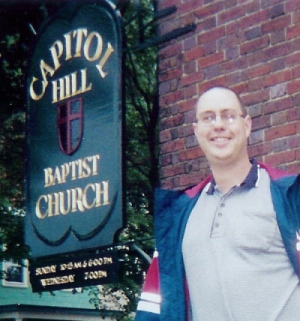
Mr. Smith Goes to Washington - a Report on the Weekender at Capitol Hill Baptist Church, Washington, D. C.

"We want your churches to display the character of God." – Matt Schmucker, Director of 9Marks Ministries
Having the last name of Smith occasionally invites the question, "Have you ever seen the film, Mr. Smith Goes to Washington?" Until recently, my answer was no, but my wife and I recently viewed that classic movie about the naïve youth leader-become-congressman. The story is about Smith, who gets appointed to replace a senator who dies while still holding office. The politicians assume that the new congressman will be a yes-man and will not discover and expose some illegal plans they have. Smith becomes disillusioned by the corruption he finds in politics, including the duplicity of one of his political heroes, who he once greatly respected. Smith discovers the deceit and manipulation, and refuses to participate in it. After a good bit of wrestling with a pitiable situation in which he is falsely accused of a ploy to profit from a piece of legislation, Smith stages an impressive filibuster which exhausts him and leads to public confession of the secret plot, as one of the perpetrators comes clean.
This Mr. Smith has never had an experience quite like that, but I did get to go to Washington, D. C. to get a better understanding of God’s plan for the local church, including learning how men appointed and called by God as pastors are supposed to serve faithfully as shepherds of God’s sheep. Faithful shepherding includes dealing with error in the local church and avoiding the pressures to compromise that are prevalent in the ministry just as they are in politics.
My friend John Beeler and I attended the Weekender at Capitol Hill Baptist Church (CHBC) during September 14-18, 2006, sponsored by 9Marks Ministries. The Weekender is an intensive pastoral ministry conference. One could describe it as an immersion in the theory and practice of eccelesiology (the study of the church). It was a combination of getting to be a fly on the wall to see what a healthy church looks like and does, and of being a slow-draining sink into which the knowledge and experience of the conference is still sinking. Over 50 pastors and aspiring pastors profited from the many sessions, which included substantive interaction, encouraging fellowship, helpful instruction, and late nights. CHBC is intentionally Biblical, avoiding the popular market-driven, consumer-oriented philosophies of church growth. They clearly define success as faithfulness to God, and reminded us that, in the words of B. B. Warfield, "Looseness of belief is the inevitable parent of looseness of practice." . We were given the opportunity to attend an elders’ meeting, seminars on various aspects of the church, workshops on service planning and sermon preparation, membership courses, Sunday services, evaluations of sermons and the service, a members meeting (which included a church discipline case), and a final evaluation. There was much time for questions and answers, and interaction with the church staff and fellow attendees. What follows is an overview of what we experienced. I have written it to encourage those who are pastors or aspiring pastors to attend this "particularly helpful" event (as they would say at CHBC!).
Preaching
According to Mark Dever, the first mark of a healthy church, from which the rest of the church’s health flows, is expositional preaching. Before being asked to change, people need to see the basis for change in the Word. Dever, senior pastor of CHBC, spoke about sermon preparation and service planning. His desire is that church members be more familiar with Bible books than popular Christian books. For example, should they read a book on How I Can Be Sure I’m a Christian…or 1 John? Dever is a strong advocate of preaching expositional sermons, which he defines as sermons in which "the point of the passage is the point of the message."
Dever said, "I think you can preach any size of text in any length of time." One can take a variety of views of the Bible, zooming in and out and looking at different levels. Dever believes beginning pastors should do the hard but rewarding work of preaching many overview sermons, taking larger sections of text – particularly, whole books (and even whole testaments!). This fills the mouth with Scripture and enables one to present the message of the book, the purpose for which it was written. Helpful tools for this task include William Dumbrell’s book, The Faith of Israel, one volume Bible commentaries, and commentators such as John Calvin, John Gill (often underrated, but an expert expositor, exegete, and master of Biblical languages), and Matthew Henry.
After preaching overview sermons, Dever recommends preaching through books, outlining the whole book in advance (much of the work for this will be done if an overview sermon on the book has already been preached). His goal is to preach through the Bible, not over his whole lifetime, but in a shorter time period, to benefit his congregation and give them an understanding of the whole of Scripture.
For preparation, one should read the text again and again and again; meditate; and pray throughout the process. The text must be exegeted and an exegetical outline produced. Dever emphasized that one does not need to know the original languages to do faithful exegesis, and that a good translation of the Bible will suffice. He said that many guys who don’t know the languages are unnecessarily insecure. He reminded us of preachers who were not masters of Hebrew and Greek, such as Whitefield, Bunyan, and Mahaney. Dever said that some guys who know the language falsely assume that the more language they know, the better their preaching will be – but this is not necessarily so. After the exegetical outline, the application grid can be filled in (all of these will not always be used in the sermon, but it is a helpful exercise). Then a homiletical outline can be crafted, in which one should try to let the text speak. At this point, the sermon may be written out in its entirety. Mark preaches from a full manuscript to be more direct, more clear, and less repetitious, but says that each preacher must know himself in this matter.
As for the elements of the sermon, introductions should start with what interests hearers. The sermon should begin with a demonstration of relevance, urgency, and importance, starting with the listener. The preacher must assume deep disinterest on the part of people sitting there, and seek to gain their attention. The introduction must also engage the nonChristian and the Christian.
The body of a sermon should make a few points and make them well. Application must be included. (Dever stated that much evangelical preaching is actually weak in this area.) Mark front-loads his introductions with application, applies throughout (putting application with each point), and applies to a variety of people (using application grid – available online at http://www.9marks.org/, under expositional preaching, or by clicking here). Mark spends about 24-30 hours on each sermon, and preaches between forty-five and sixty-five minutes. He consults others in his preparation to be sure he is communicating clearly.
Dever plans extensively, printing a sermon card announcing texts and titles months in advance. This helps the preacher avoid "Saturday night fever" (the weekly anxiety of many preachers as they prepare their sermon the night before), and enables the congregation to prepare by reading the upcoming Scripture text in their daily quiet times. It also has evangelistic use, helping the congregation to invite others. Mark rotates through the various genres of Scripture, so that in a few months time, one will have been exposed to all the literary genres in Scripture (OT: Law, Prophecy, History, Wisdom; NT: Gospel, Pauline Epistle, General Epistle). He has another preacher speak in the evening on the same theme but from a passage in the opposite testament (a fifteen-minute sermon he compared to an after-dinner mint). Mark anticipated the question some might raise, "Where is there room for the Holy Spirit’s leading in this type of planning?" He proceeded to distribute a past sermon card that included the September 11 time period (it can be viewed or downloaded here). The messages were planned well in advance, but were remarkably appropriate for the unpredictable terrorist attacks, covering passages that dealt with security, justice, mercy, questions for God (series on Habakkuk titled "When Bad Things Happen"), and our need to trust in Him. It does appear that God can use advance planning!
CHBC staff meets weekly to review the sermon, encouraging and critiquing the preacher, and giving suggestions. It was a wonderful experience to hear Mark’s excellent and profitable sermon on Ruth 4. Then we witnessed the sermon review a few hours later. The sermon review was a great display of giving and receiving godly criticism, traits CHBC desires to be central to their ministry. Mark Dever sat and listened as 20-something interns (as well as other staff) evaluated his sermon. It was a great example of humility and a willingness to be taught by others.
Dever recommends these books on preaching: John R. W. Stott, Between Two Worlds (best single book) and D. Martyn-Lloyd Jones, Preaching and Preachers (his favorite book on preaching). He highly recommends two workshops/conferences devoted specifically to preaching: the Simeon Trust Conference (Kent Hughes and others) in America and the Proclamation Trust (Dick Lucas) in England.
Other helpful resources are Dever’s books: overview sermons in Promises Made: the Message of the Old Testament and Promises Kept: the Message of the New Testament; Nine Marks of a Healthy Church; and The Deliberate Church. There is much helpful audio available online for free, including sermons, lectures, and interviews at http://www.capitolhillbaptist.org/, http://www.chbcaudio.org/, and http://www.9marks.org/. Leadership
The first major event of the conference was the elders’ meeting. Prior to the meeting, we were oriented to what would happen. We were warned that we were about to go into "the deep end" and that the goal would be to "swim to the edges" by the end of the Weekender, a very fitting metaphor.
At the meeting, we sang "It is Well with My Soul," the men read Scripture (from Ruth 4, which Mark Dever, the senior pastor, would soon be preaching from) and praised God for His merciful kindness. The meeting was a powerful display of accountability, transparency, humility, and love, as the elders prayed for the congregation and one another. They discussed future plans of the church, including considerations for evangelistic outreach. We were dismissed before the final portion of the meeting, in which they discussed men who could potentially be future elders in the church.
CHBC is congregational in its church government, but elder-led. They have a plurality of elders because of the frequent New Testament references to elders in the local church using the word in the plural. They are congregational because of the authority of the local church stated in Matthew 18 and 1 Corinthians 5 (mentioned specifically in the context of church discipline). Elders must be men who are apt to teach, not just anyone who is available. They must evidence elder-type behavior in congregation before formal recognition, undergo rigorous examination by other elders and receive their unanimous approval, and then they must be chosen by a 75% vote of the congregation.
The local church holds the responsibility to recognize and train elders. As Michael Lawrence, associate pastor at CHBC, said, "Seminaries do not make pastors; churches make pastors."
One way CHBC trains elders is through its internship program. This is a semester-long, intensive time of discipleship and observation for the interns. They have numerous reading and writing assignments (including Iain Murray’s The Reformation of the Church, and Charles Bridges, The Christian Ministry, as well as Mark Dever’s books), must be present at all church activities, are held accountable for their time, and undergo evaluation. Men have done the internship before, during, and after going to seminary. (One of the men who attended the same Weekender has just begun his internship at CHBC and has a more extensive list on his blog.)
Membership & Discipline
"If you’re not a member of the church you regularly attend, you may well be on your way to hell." These intentionally arresting words were spoken by Mark Dever in the "Membership Matters" classes, prerequisite to joining CHBC. He was not arguing that church membership is necessary for salvation, but that it naturally should follow it. CHBC takes membership seriously, believing that God has saved us to be a part of a community, and that He has saved us not to have ourselves served but to serve others. They emphasize that the Christian life is not merely one’s own private business, but that we are to serve one another (even with seemingly mundane things like showing up early) and build up one another in the faith.
Dever gave five reasons to join a Christian church: for the sake of 1) nonChristians; 2) weaker Christians; 3) stronger Christians; 4) church leaders; and 5) God.
Three documents were mentioned as an important part of a church’s identity: the Statement of Faith (what we believe - guards unity, protects from error, makes known the church’s doctrinal distinctives), the Church Covenant (what we promise to do – an agreement before God, the church, and ourselves of how we promise to live together as a church), and the Church Constitution.
Attendance, particularly at the Sunday morning worship service, is especially important. Absence from attending is seen as a portal to sin (a dangerous separation of one from God’s people that makes one more vulnerable to sin) or a reflection of sin (not attending because one knows he is doing wrong). Those who persist in nonattendance get excommunicated – removed from the church membership rolls. Discipline also occurs for members living in open sin. The goal of discipline is to restore the believer, but to also warn others that the church cannot give testimony to their salvation (one purpose of membership) when they are walking contrary to God.
Implementing Change
CHBC began because of a woman’s burden for a prayer meeting on Capitol Hill. The church had a good history and remained committed to the Scriptures over the years. When Dever was contacted to consider the pastorate, the church had been through the trauma of a necessary departure of its previous pastor. The church had far more names on the membership rolls than in attendance (a sad but common situation in many American churches), and was in need of reform (see Matt Schmucker's testimony here). Among the changes needed were a plurality of elders, a more meaningful understanding of membership, and the practice of Biblical church discipline. God brought wonderful changes, but he did not do so overnight. Some changes took years, work, and the unpleasant task of facing opposition to occur, and CHBC warned us that one could not expect to take the instruction received at the Weekender and immediately expect all the same results in another local church. Each church is different and has its own culture, background, and circumstances.
At the Weekender, we were instructed about the need for care and patience in making changes in a church. Appreciating and learning the history of a local church is a helpful factor for the pastor hoping to move the church in a healthy direction. Dever did not try to do anything without "teaching on it and teaching on it and teaching on it" first (such as going to a plurality of elders and relegating deacons to a servant role instead of having them oversee matters). He said, "Matt [Schmucker, director of 9Marks Ministries, who also serves as an elder at CHBC] and I have never criticized a pastor for moving too slowly." Dever admits that he had optimal conditions for change, implying that one cannot expect a direct correlation in another local church; for others change may happen on a much different timetable. He strongly urged pastors to consider their conditions before trying to implement changes. He also told us that healthy churches and long pastorates tend to go together.
Contact Information
This Mr. Smith had a great trip to Washington. Instead of political corruption, I saw Biblical faithfulness on Capitol Hill. I benefited greatly from the Weekender, am very grateful for it, and highly recommend it to those who want to know more about the philosophy and practice of a healthy church. Scholarships are available for those with whom affordability is a concern. The Weekender is usually offered three times per year. Learn more or sign up for a Weekender by clicking here or visit http://www.9marks.org/ or http://www.capitolhillbaptist.org/. There is often a waiting list, so register early. Also, visit the CHBC and 9Marks websites for plenty of free materials, including recordings of sermons, outlines and notes from Sunday School classes (CORE seminars), downloadable books, and leadership interviews. This article was adapted and updated from a two-part article originally posted at www.sharperiron.org: Part 1 and Part 2

Friday, August 10, 2007

Grudem and Piper Discuss Necessity of Baptism for Church Membership

Is baptism by immersion (upon profession of faith in Christ) necessary for church membership? Does excluding someone from church membership amount to a de facto excommunication in terms of how the person is treated? A revision in Wayne Grudem's Systematic Theology has generated some serious discussion between John Piper and Grudem. Justin Taylor drew attention to this matter at at his blog. Piper's thoughts are here and Grudem's response is here.

Concerning this issue, Southern Seminary has some relevant audio:

Also, I was listening to Dever today on John L. Dagg (from a conference in which he also spoke on Bunyan), and he referenced Dagg's Manual of Church Order as a good resource for dealing with this issue.

UPDATE: This really generated a good bit of discussion! I'm glad Justin Taylor kept track of it. You can follow the discussion here, and you might also be interested in this recent book on believer's baptism, edited by Tom Schreiner and Shawn Wright.

Friday, January 12, 2007

Weekender articles at Sharper Iron
"Mr. Smith Goes to Washington" is a two-part article about my trip to the Weekender at Capitol Hill Baptist Church in Washington, D.C., in September of 2006.

Part 1 is here: http://www.sharperiron.org/2007/01/11/mr-smith-goes-to-washington-part-1/

Part 2 is here:
(Ben Wright interacts a bit with the article here, particularly concerning fundamentalism: http://paleoevangelical.blogspot.com/2007/01/out-fundamentalling-fundamentalists.html )