"We want your churches to display the character of God." – Matt Schmucker, Director of 9Marks Ministries
Having the last name of Smith occasionally invites the question, "Have you ever seen the film, Mr. Smith Goes to Washington?" Until recently, my answer was no, but my wife and I recently viewed that classic movie about the naïve youth leader-become-congressman. The story is about Smith, who gets appointed to replace a senator who dies while still holding office. The politicians assume that the new congressman will be a yes-man and will not discover and expose some illegal plans they have. Smith becomes disillusioned by the corruption he finds in politics, including the duplicity of one of his political heroes, who he once greatly respected. Smith discovers the deceit and manipulation, and refuses to participate in it. After a good bit of wrestling with a pitiable situation in which he is falsely accused of a ploy to profit from a piece of legislation, Smith stages an impressive filibuster which exhausts him and leads to public confession of the secret plot, as one of the perpetrators comes clean.
This Mr. Smith has never had an experience quite like that, but I did get to go to Washington, D. C. to get a better understanding of God’s plan for the local church, including learning how men appointed and called by God as pastors are supposed to serve faithfully as shepherds of God’s sheep. Faithful shepherding includes dealing with error in the local church and avoiding the pressures to compromise that are prevalent in the ministry just as they are in politics.
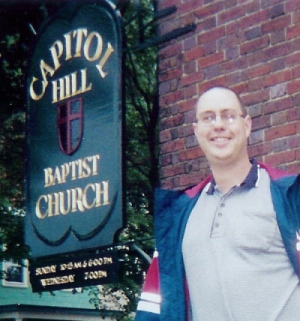
My friend John Beeler and I attended the Weekender at Capitol Hill Baptist Church (CHBC) during September 14-18, 2006, sponsored by 9Marks Ministries. The Weekender is an intensive pastoral ministry conference. One could describe it as an immersion in the theory and practice of eccelesiology (the study of the church). It was a combination of getting to be a fly on the wall to see what a healthy church looks like and does, and of being a slow-draining sink into which the knowledge and experience of the conference is still sinking. Over 50 pastors and aspiring pastors profited from the many sessions, which included substantive interaction, encouraging fellowship, helpful instruction, and late nights.
CHBC is intentionally Biblical, avoiding the popular market-driven, consumer-oriented philosophies of church growth. They clearly define success as faithfulness to God, and reminded us that, in the words of B. B. Warfield, "Looseness of belief is the inevitable parent of looseness of practice." . We were given the opportunity to attend an elders’ meeting, seminars on various aspects of the church, workshops on service planning and sermon preparation, membership courses, Sunday services, evaluations of sermons and the service, a members meeting (which included a church discipline case), and a final evaluation. There was much time for questions and answers, and interaction with the church staff and fellow attendees. What follows is an overview of what we experienced. I have written it to encourage those who are pastors or aspiring pastors to attend this "particularly helpful" event (as they would say at CHBC!).
Preaching
According to Mark Dever, the first mark of a healthy church, from which the rest of the church’s health flows, is expositional preaching. Before being asked to change, people need to see the basis for change in the Word. Dever, senior pastor of CHBC, spoke about
sermon preparation and
service planning. His desire is that church members be more familiar with Bible books than popular Christian books. For example, should they read a book on How I Can Be Sure I’m a Christian…or 1 John? Dever is a strong advocate of preaching expositional sermons, which he defines as sermons in which "the point of the passage is the point of the message."
Dever said, "I think you can preach any size of text in any length of time." One can take a variety of views of the Bible, zooming in and out and looking at different levels. Dever believes beginning pastors should do the hard but rewarding work of preaching many overview sermons, taking larger sections of text – particularly, whole books (and even whole testaments!). This fills the mouth with Scripture and enables one to present the message of the book, the purpose for which it was written. Helpful tools for this task include William Dumbrell’s book,
The Faith of Israel, one volume Bible commentaries, and commentators such as John Calvin, John Gill (often underrated, but an expert expositor, exegete, and master of Biblical languages), and Matthew Henry.
After preaching overview sermons, Dever recommends preaching through books, outlining the whole book in advance (much of the work for this will be done if an overview sermon on the book has already been preached). His goal is to preach through the Bible, not over his whole lifetime, but in a shorter time period, to benefit his congregation and give them an understanding of the whole of Scripture.
For preparation, one should read the text again and again and again; meditate; and pray throughout the process. The text must be exegeted and an exegetical outline produced. Dever emphasized that one does not need to know the original languages to do faithful exegesis, and that a good translation of the Bible will suffice. He said that many guys who don’t know the languages are unnecessarily insecure. He reminded us of preachers who were not masters of Hebrew and Greek, such as Whitefield, Bunyan, and Mahaney. Dever said that some guys who know the language falsely assume that the more language they know, the better their preaching will be – but this is not necessarily so. After the exegetical outline, the application grid can be filled in (all of these will not always be used in the sermon, but it is a helpful exercise). Then a homiletical outline can be crafted, in which one should try to let the text speak. At this point, the sermon may be written out in its entirety. Mark preaches from a full manuscript to be more direct, more clear, and less repetitious, but says that each preacher must know himself in this matter.
As for the elements of the sermon, introductions should start with what interests hearers. The sermon should begin with a demonstration of relevance, urgency, and importance, starting with the listener. The preacher must assume deep disinterest on the part of people sitting there, and seek to gain their attention. The introduction must also engage the nonChristian and the Christian.
The body of a sermon should make a few points and make them well. Application must be included. (Dever stated that much evangelical preaching is actually weak in this area.) Mark front-loads his introductions with application, applies throughout (putting application with each point), and applies to a variety of people (using application grid – available online at
http://www.9marks.org/, under expositional preaching, or by clicking
here).
Mark spends about 24-30 hours on each sermon, and preaches between forty-five and sixty-five minutes. He consults others in his preparation to be sure he is communicating clearly.
Dever plans extensively, printing a sermon card announcing texts and titles months in advance. This helps the preacher avoid "Saturday night fever" (the weekly anxiety of many preachers as they prepare their sermon the night before), and enables the congregation to prepare by reading the upcoming Scripture text in their daily quiet times. It also has evangelistic use, helping the congregation to invite others. Mark rotates through the various genres of Scripture, so that in a few months time, one will have been exposed to all the literary genres in Scripture (OT: Law, Prophecy, History, Wisdom; NT: Gospel, Pauline Epistle, General Epistle). He has another preacher speak in the evening on the same theme but from a passage in the opposite testament (a fifteen-minute sermon he compared to an after-dinner mint). Mark anticipated the question some might raise, "Where is there room for the Holy Spirit’s leading in this type of planning?" He proceeded to distribute a past sermon card that included the September 11 time period (it can be viewed or downloaded
here). The messages were planned well in advance, but were remarkably appropriate for the unpredictable terrorist attacks, covering passages that dealt with security, justice, mercy, questions for God (series on Habakkuk titled "When Bad Things Happen"), and our need to trust in Him. It does appear that God can use advance planning!
CHBC staff meets weekly to review the sermon, encouraging and critiquing the preacher, and giving suggestions. It was a wonderful experience to hear Mark’s excellent and profitable
sermon on Ruth 4. Then we witnessed the sermon review a few hours later. The sermon review was a great display of giving and receiving godly criticism, traits CHBC desires to be central to their ministry. Mark Dever sat and listened as 20-something interns (as well as other staff) evaluated his sermon. It was a great example of humility and a willingness to be taught by others.
The first major event of the conference was the elders’ meeting. Prior to the meeting, we were oriented to what would happen. We were warned that we were about to go into "the deep end" and that the goal would be to "swim to the edges" by the end of the Weekender, a very fitting metaphor.
At the meeting, we sang "It is Well with My Soul," the men read Scripture (from Ruth 4, which Mark Dever, the senior pastor, would soon be preaching from) and praised God for His merciful kindness. The meeting was a powerful display of accountability, transparency, humility, and love, as the elders prayed for the congregation and one another. They discussed future plans of the church, including considerations for evangelistic outreach. We were dismissed before the final portion of the meeting, in which they discussed men who could potentially be future elders in the church.
CHBC is congregational in its church government, but elder-led. They have a plurality of elders because of the frequent New Testament references to elders in the local church using the word in the plural. They are congregational because of the authority of the local church stated in Matthew 18 and 1 Corinthians 5 (mentioned specifically in the context of church discipline).
Elders must be men who are apt to teach, not just anyone who is available. They must evidence elder-type behavior in congregation before formal recognition, undergo rigorous examination by other elders and receive their unanimous approval, and then they must be chosen by a 75% vote of the congregation.
The local church holds the responsibility to recognize and train elders. As Michael Lawrence, associate pastor at CHBC, said, "Seminaries do not make pastors; churches make pastors."
One way CHBC trains elders is through its internship program. This is a semester-long, intensive time of discipleship and observation for the interns. They have numerous reading and writing assignments (including Iain Murray’s
The Reformation of the Church, and Charles Bridges,
The Christian Ministry, as well as Mark Dever’s books), must be present at all church activities, are held accountable for their time, and undergo evaluation. Men have done the internship before, during, and after going to seminary. (One of the men who attended the same Weekender has just begun his internship at CHBC and has a more extensive list on
his blog.)
Membership & Discipline
"If you’re not a member of the church you regularly attend, you may well be on your way to hell." These intentionally arresting words were spoken by Mark Dever in the "Membership Matters" classes, prerequisite to joining CHBC. He was not arguing that church membership is necessary for salvation, but that it naturally should follow it. CHBC takes membership seriously, believing that God has saved us to be a part of a community, and that He has saved us not to have ourselves served but to serve others. They emphasize that the Christian life is not merely one’s own private business, but that we are to serve one another (even with seemingly mundane things like showing up early) and build up one another in the faith.
Dever gave five reasons to join a Christian church: for the sake of 1) nonChristians; 2) weaker Christians; 3) stronger Christians; 4) church leaders; and 5) God.
Three documents were mentioned as an important part of a church’s identity: the Statement of Faith (what we believe - guards unity, protects from error, makes known the church’s doctrinal distinctives), the Church Covenant (what we promise to do – an agreement before God, the church, and ourselves of how we promise to live together as a church), and the Church Constitution.
Attendance, particularly at the Sunday morning worship service, is especially important. Absence from attending is seen as a portal to sin (a dangerous separation of one from God’s people that makes one more vulnerable to sin) or a reflection of sin (not attending because one knows he is doing wrong). Those who persist in nonattendance get excommunicated – removed from the church membership rolls. Discipline also occurs for members living in open sin. The goal of discipline is to restore the believer, but to also warn others that the church cannot give testimony to their salvation (one purpose of membership) when they are walking contrary to God.
Implementing Change
CHBC began because of a woman’s burden for a prayer meeting on Capitol Hill. The church had a good history and remained committed to the Scriptures over the years. When Dever was contacted to consider the pastorate, the church had been through the trauma of a necessary departure of its previous pastor. The church had far more names on the membership rolls than in attendance (a sad but common situation in many American churches), and was in need of reform (see Matt Schmucker's testimony
here). Among the changes needed were a plurality of elders, a more meaningful understanding of membership, and the practice of Biblical church discipline. God brought wonderful changes, but he did not do so overnight. Some changes took years, work, and the unpleasant task of facing opposition to occur, and CHBC warned us that one could not expect to take the instruction received at the Weekender and immediately expect all the same results in another local church. Each church is different and has its own culture, background, and circumstances.
At the Weekender, we were instructed about the need for care and patience in making changes in a church. Appreciating and learning the history of a local church is a helpful factor for the pastor hoping to move the church in a healthy direction. Dever did not try to do anything without "teaching on it and teaching on it and teaching on it" first (such as going to a plurality of elders and relegating deacons to a servant role instead of having them oversee matters). He said, "Matt [Schmucker, director of 9Marks Ministries, who also serves as an elder at CHBC] and I have never criticized a pastor for moving too slowly." Dever admits that he had optimal conditions for change, implying that one cannot expect a direct correlation in another local church; for others change may happen on a much different timetable. He strongly urged pastors to consider their conditions before trying to implement changes. He also told us that healthy churches and long pastorates tend to go together.
Contact Information
This Mr. Smith had a great trip to Washington. Instead of political corruption, I saw Biblical faithfulness on Capitol Hill. I benefited greatly from the Weekender, am very grateful for it, and highly recommend it to those who want to know more about the philosophy and practice of a healthy church. Scholarships are available for those with whom affordability is a concern. The Weekender is usually offered three times per year. Learn more or sign up for a Weekender by clicking
here or visit
http://www.9marks.org/ or
http://www.capitolhillbaptist.org/. There is often a waiting list, so register early. Also, visit the CHBC and 9Marks websites for plenty of free materials, including
recordings of sermons, outlines and notes from Sunday School classes (
CORE seminars), downloadable books, and
leadership interviews.
This article was adapted and updated from a two-part article originally posted at www.sharperiron.org: Part 1 and Part 2
 from the Concord Baptist Church website: